
Think the cheapest transfer always saves you money?
Not always. Private rides can beat shared shuttles once you split the fare, and shared shuttles often win for solo travelers or couples on a tight budget.
Which suits you best depends on what you value most: price, door to door time, luggage rules, or privacy.
Read on and we’ll break down costs, wait times, baggage rules, and real use cases so you can pick the smarter option fast.
Core Comparison Insights for Airport Transfers

Choosing between private and shared airport transfers comes down to what you’re willing to trade: upfront cost versus total trip time and convenience. Private transfers charge one price for the whole vehicle (usually $40–$200 depending on distance), while shared shuttles bill per person (often $8–$35 each). Shared options look cheaper at first. But the math flips when you’re traveling with three or more people. A private sedan at $80 split three ways drops to about $27 per person, putting it right in line with shared shuttle rates.
The real practical gap? How long you spend getting to your door. Private transfers follow a direct route from airport to hotel. Shared shuttles stop for each booked passenger. On routes like Geneva to Morzine, private rides can finish up to an hour faster. Shared services also lock you into fixed schedules, so a flight delay can mean waiting for the next departure slot.
Private transfers give you full control over departure timing, quiet space, and room for all your luggage at no extra charge. Shared shuttles bring a sociable vibe and a smaller carbon footprint per passenger, but you might hit baggage limits or pay extra fees for skis and snowboards.
Private Transfer Strengths:
- Flexible pickup times that match your flight arrival
- Direct door to door routing with no detours
- Guaranteed luggage and ski equipment space
Shared Transfer Strengths:
- Lower per person cost for solo travelers or couples
- Regular scheduled departures on popular routes
- Communal travel experience and lower emissions per rider
Understanding Private Airport Transfers for Smarter Trip Planning

Private airport transfers reserve an entire vehicle for you and your party, with a driver waiting in the arrivals hall holding your name or booking reference. The vehicle goes straight to your hotel, chalet, or apartment without stopping for anyone else. Vehicles range from sedans for solo business trips to minivans for families and full size coaches for groups of up to fifteen.
Modern private transfer providers equip cars with winter tires for alpine routes. Experienced drivers know mountain passes and city centers equally well. Many services include free baby seats, booster seats, and ski or snowboard racks. During peak ski season (December through February), availability on popular routes like Geneva to Val Thorens or Geneva to Tignes can sell out early. Booking several weeks ahead is often necessary.
The main trade off is cost. A private transfer for a single traveler or couple will usually be more expensive than two shared shuttle tickets. On the upside, you avoid the risk of shared shuttle delays when other passengers arrive late or when the vehicle makes five stops before reaching your resort.
Ideal Scenarios for Choosing a Private Transfer
Private transfers work best when your schedule is tight or your destination is remote. If you land after midnight or depart before dawn, shared shuttles may not run at those hours. Families traveling with ski gear, snowboards, and multiple suitcases appreciate the guaranteed trunk space without surcharges. Business travelers who need to make calls or review presentations en route value the privacy and quiet. And groups of three to eight find that splitting a private fare often costs the same or less per person than separate shared tickets.
Shared Airport Transfers and Shuttle Options Explained

Shared shuttles collect passengers from the same flight or arrival window and follow a fixed route with multiple drop off points. Some routes run on a rolling schedule, every thirty or sixty minutes during busy periods, while others coordinate around flight arrival times published weeks in advance. When you book, you receive a designated pickup location and a time window, often framed as “your shuttle departs within sixty minutes of your actual landing time.”
If your flight is delayed, you usually wait for the next scheduled shuttle or join the next group heading to your destination. The routing depends on the other passengers. If three people are going to nearby hotels and two to a chalet further up the valley, the driver follows a sequence that minimizes total travel time for the group, not for you alone. That means longer trips and unpredictable stop order.
Luggage allowances are stricter. Most shared providers permit one or two standard checked bags per person, and you may pay an extra $5 to $20 for skis, snowboards, or oversized cases. If you show up with three suitcases and two sets of equipment, you might not fit on the scheduled run and have to wait for the next one.
When Shared Shuttles Are the Better Choice
Shared shuttles excel on high frequency routes linking major airports to city centers or large resorts. Geneva to Morzine, Salzburg to Saalbach, and similar corridors see shuttles running several times per hour during peak season. If you’re a solo traveler or couple on a flexible itinerary, the per person savings (often $10 to $30 each) can justify an extra twenty minutes and a couple of stops. Younger travelers and backpackers often enjoy the social aspect. And sharing a vehicle lowers your carbon footprint compared to booking a car for yourself.
Cost Comparison of Private vs Shared Airport Transfers

Private transfers quote a total vehicle fare, not a per seat rate. Short city airport runs (five to ten miles) typically cost $40 to $70 for a sedan. Medium distance transfers, such as airport to suburban hotel or nearby resort (twenty to forty miles), range from $80 to $150. Long alpine runs (forty plus miles with mountain roads) can reach $120 to $200 or more for a van. You split that fare across however many passengers you bring.
Shared shuttles charge each passenger individually. City center routes often cost $8 to $15 per person, while longer suburban or resort transfers run $20 to $35 each. If you’re traveling alone, the shared shuttle almost always wins on price. With two people, a private sedan at $80 divided by two equals $40 per person, which can still be higher than a shared ticket. At three passengers, though, you’re down to about $27 each, and the private option becomes competitive. By four passengers, private is often cheaper per person than shared.
| Route Type | Private Cost Range | Shared Cost Range (per person) | Extra Time for Shared |
|---|---|---|---|
| Short (5–12 miles) | $40–$70 | $8–$15 | +10–20 min |
| Medium (20–40 miles) | $80–$150 | $20–$35 | +15–30 min |
| Long (40–60 miles) | $120–$200 | $25–$40 | +30–60 min |
Practical cost calculation tips:
- Divide the quoted private fare by your number of passengers, then compare that to the per person shared rate plus any baggage surcharges.
- Add $5 to $20 per oversized item (skis, boards, golf clubs) to your shared shuttle quote if those apply.
- Check whether tolls, parking fees, or fuel surcharges appear on top of the base price for private services.
- For groups of three or more, private fares often work out equal to or cheaper than the sum of individual shared tickets.
Travel Time, Reliability, and Scheduling Differences

Most private transfer providers track your inbound flight in real time, so the driver adjusts pickup timing if you land early or late. When you clear customs, the driver is already waiting in arrivals or messages you with the exact meeting spot. From there, the route is direct. No detours unless you ask to stop for groceries. Total door to door time matches the normal drive duration, plus a few minutes to load luggage.
Shared shuttles coordinate around published pickup windows. If your flight lands at 2:10 PM and the next shuttle departs at 3:00 PM, you wait. If the flight is delayed by an hour, you might miss that slot and board the 4:30 PM run instead. The shuttle itself makes multiple stops. It may visit four hotels in the valley before dropping you at the fifth. Each stop adds five to ten minutes, and if another passenger takes a while finding their luggage or confirming their room, those delays stack.
On popular ski transfer routes, the time difference can be substantial. A direct private ride from Geneva to Morzine takes roughly one hour. A shared shuttle covering the same route with three intermediate stops can stretch to two hours. For shorter city transfers, the gap is smaller, maybe ten to twenty extra minutes, but it still matters if you have a meeting or a tight connection onward.
Privacy, Comfort, and Onboard Experience Compared

Inside a private vehicle, you control the environment. You can adjust the temperature, play your own music, make phone calls, or sit in silence. Business travelers use the trip to catch up on email or review slides before a conference. Families with young children appreciate being able to hand out snacks, change a diaper, or let kids nap without worrying about disturbing strangers.
Shared shuttles seat eight to twenty passengers in a minivan or small coach. You share space with travelers you’ve never met, and noise levels vary. Some passengers chat, others sleep, and a few make calls. Legroom and seat comfort are standard minibus grade. Functional but not luxurious. During peak season, all seats may be full, leaving little extra room for coats or bags. You also have no say in the route order, so you might be the last drop off even if your hotel is geographically second.
Unique experiential elements:
- Private transfers let you request specific music, stops for photos, or temperature adjustments mid trip.
- Private services often use newer sedans or SUVs with more legroom and quieter cabins than shared shuttle vans.
- Shared shuttles limit personal phone calls or work because you’re surrounded by other passengers.
- Shared vehicles may feel crowded when every seat is occupied and all luggage racks are full.
Luggage Capacity, Accessibility, and Special Requirements
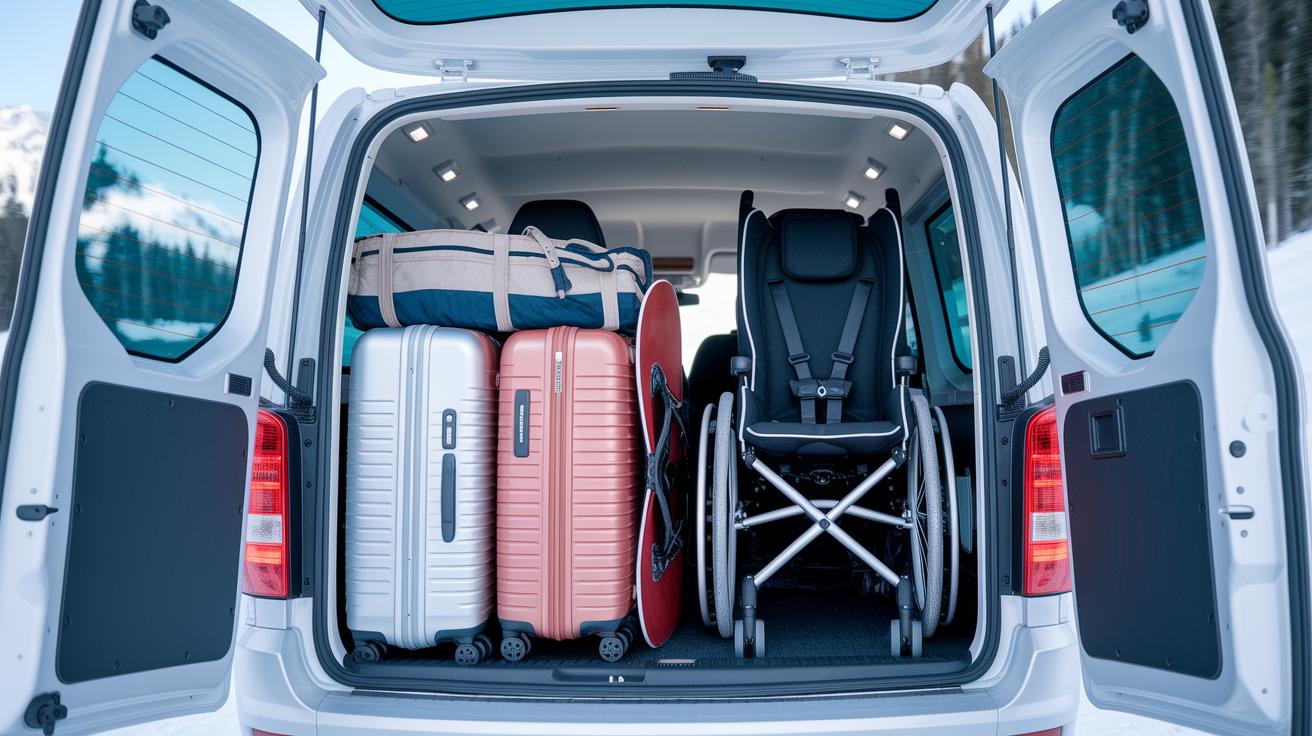
Private transfers let you choose the right vehicle size for your bags. A sedan handles two to four standard suitcases, an SUV fits four to six, and a minivan or van accommodates six to twenty depending on configuration. If you’re traveling with ski equipment, baby strollers, or a wheelchair, you tell the booking team in advance and they assign a vehicle with the necessary space and features. Baby seats and booster seats are typically free, and ski or snowboard racks come standard on alpine routes.
Shared shuttles enforce stricter allowances. Most providers permit one or two checked bags per passenger, each within airline dimensions. Oversized items (skis longer than standard cases, snowboards, golf clubs, or surfboards) often incur a $5 to $20 surcharge per item. If your group brings three large suitcases each plus equipment, you may exceed the shuttle’s total capacity and have to split across two departures or upgrade to a private option. Mobility equipment such as wheelchairs or walkers can be accommodated on some shuttles, but you must notify the provider at booking and confirm space availability.
| Transfer Type | Luggage Allowance | Oversized Item Policy |
|---|---|---|
| Private (sedan/SUV) | 2–6 checked bags | Included, no extra fee |
| Private (van/minibus) | 6–20 checked bags | Included, no extra fee |
| Shared shuttle | 1–2 checked bags per person | $5–$20 surcharge per item |
Which Travelers Should Choose Private vs Shared Transfers

Your ideal transfer type depends less on abstract pros and cons and more on your exact travel context. Group size, schedule constraints, luggage load, and budget tolerance all shift the calculation.
Solo Travelers
If you’re flying solo on a well served route with frequent shuttles and your flight lands during normal daytime hours, a shared shuttle saves you the most money. The per person fare is low, and the extra twenty minutes rarely matters when you have no onward commitments. Solo business travelers with tight schedules or late arrivals often still choose private transfers to guarantee on time pickup and quiet space for calls.
Families
Families with two adults and one or two children hit the private break even point quickly. A family of four paying $25 each for shared tickets spends $100, which is often equal to or more than a single private van. Add in ski equipment, strollers, and the hassle of coordinating young kids through multiple shuttle stops, and private becomes the smoother choice. Free baby seats and the ability to stop for a restroom break without asking a driver to alter the route add real value.
Business Travelers
Business travelers prioritize reliability and productivity. A private transfer guarantees you land, clear customs, and reach your hotel on a fixed timeline. You can take confidential calls, review sensitive documents, or simply rest without sharing space. Flight delays are handled automatically via tracking, and you avoid the risk of missing a shuttle and waiting an hour for the next one. The premium over shared tickets is usually justified by the time saved and stress avoided.
Groups
Groups of three to eight people almost always find private transfers more cost effective. A private van for eight at $150 divided by eight passengers is less than $19 per person, well below most shared shuttle rates for medium or long routes. Larger groups (student trips, corporate delegations, wedding parties) can book minibuses or coaches through the same private providers, maintaining scheduling control and luggage capacity without paying per person shared fares that multiply quickly.
Decision Framework and Comparison Matrix

The fastest way to decide is to map your trip details against a handful of concrete criteria. Count your passengers, estimate your total luggage and equipment load, check your flight arrival time, and note how flexible your onward schedule is.
Six decision criteria for quick selection:
- If your group size is three or more, calculate private cost per person and compare it directly to shared per person fare plus baggage fees.
- If you land late at night or depart very early in the morning, confirm shared shuttle availability at those hours before assuming you can book one.
- If you carry more than two checked bags per person or any oversized items, add surcharge estimates to your shared quote or choose private to avoid fees.
- If you have a meeting, conference check in, or onward connection within two hours of your scheduled arrival, private transfers reduce delay risk.
- If you’re traveling alone on a high frequency route during daylight hours, shared shuttles offer the lowest cost.
- If your destination is a remote chalet or small village with infrequent shared service, private may be your only reliable option.
| Criteria | Private Transfer Score | Shared Transfer Score |
|---|---|---|
| Cost for solo traveler | Higher | Lower |
| Cost for group of 4+ | Equal or lower per person | Higher total |
| Total travel time | Shortest (direct route) | Longer (multiple stops) |
| Schedule flexibility | Matches your flight exactly | Fixed departure windows |
| Luggage and equipment | Unlimited, no fees | Limited, possible surcharges |
Final Words
In the action, we ran through head-to-head differences: private gives door-to-door speed, flexible pickup, and better luggage handling; shared cuts cost per person and lowers the footprint but adds stops and fixed schedules.
We also covered price math, travel-time tradeoffs, comfort and accessibility, and a decision framework to match the transfer to your trip.
If you weigh price, timing, and luggage needs, you’ll spot which fits. Use the private vs shared airport transfers pros and cons to pick the right transfer and enjoy a smoother start to your journey.
FAQ
Q: What are the main differences between private and shared airport transfers?
A: The main differences between private and shared airport transfers are cost basis (per‑vehicle vs per‑person), travel time (direct vs multi‑stop), flexibility (fixed schedule vs flexible pickup) and privacy/comfort levels.
Q: How do costs compare and when does private become cheaper per person?
A: Costs compare with private at about $40–$200 per ride and shared at $8–$35 per person; a private ride often breaks even around three passengers or more, depending on route and extras.
Q: How much travel time can I save with a private transfer?
A: A private transfer saves time by taking a direct route; on some routes like Geneva→Morzine it can be up to about one hour faster than a multi‑stop shared shuttle.
Q: How do private and shared transfers handle flight delays and reliability?
A: Private transfers usually include flight tracking and drivers wait 15–30 minutes after arrival, while shared shuttles run on schedules and may require waiting for the next departure if flights are delayed.
Q: What are the luggage and equipment rules for private versus shared transfers?
A: Luggage rules differ: private vehicles can be sized for 2–20 bags and often include free baby seats or ski carriage, while shared shuttles typically allow 1–2 checked bags per person and may charge for oversized items.
Q: Who should choose a private transfer and who should pick a shared shuttle?
A: Private transfers suit families, groups with equipment, business travelers, and tight schedules; shared shuttles suit solo travelers or couples on popular routes who prioritize lower cost and flexible timing.
Q: When should I book a private transfer and are there seasonal limits?
A: You should book private transfers early for peak season (Dec–Feb) and busy routes like Geneva→Val Thorens, since higher demand can limit availability and raise prices.
Q: How do privacy and onboard comfort differ between the two options?
A: Privacy and comfort differ because private transfers offer an exclusive vehicle, adjustable settings and quiet space for work or calls, while shared shuttles have mixed passengers and less control over the environment.
Q: What quick tips help me decide between private and shared transfers?
A: Quick tips: split private cost by group size, check travel time needs, count luggage and gear, factor flight reliability — choose private for timing/equipment, shared for lowest per‑person price.